Notice

admin

How Much Cash Should Students Carry to Japan?

How Much Cash Should Students Carry to Japan? Are you planning to travel from Nepal to Japan for your studies? Before booking your flight and packing your luggage, one important question is: How Much Cash Should Students Carry to Japan? Carrying too little money can make your first few days difficult, especially when you need to pay for transportation, food, a SIM card, or other essentials. Carrying too much cash, on the other hand, can create unnecessary security risks and may require you to follow currency declaration procedures. For Nepali students traveling to Japan, the best approach is to prepare a realistic first-week budget, confirm which expenses have already been paid, and understand the rules for carrying money across international borders. How Much Cash Should You Carry to Japan as a Student? There is no single amount that every student must carry. The right amount depends on your accommodation arrangements, arrival city, transportation costs, and access to funds after landing. As a practical starting point, consider carrying around ¥30,000–¥50,000 in Japanese yen for immediate expenses if your accommodation and major initial fees have already been arranged. This is a planning suggestion, not an official immigration requirement. You may need a different amount if you must pay for accommodation, a deposit, school-related expenses, or other significant costs immediately after arrival. Before deciding how much cash to bring, confirm the following: Is your accommodation already booked and paid for? Will someone from your school or accommodation provider pick you up? How will you pay for your train or bus journey from the airport? Do you have access to additional funds through an approved banking arrangement? Are there any outstanding payments due during your first week? Important: Do not rely on cash alone for your entire stay. Prepare a plan for accessing additional funds legally and securely. What Expenses Will You Have During Your First Few Days in Japan? Your initial expenses will depend on where you land and what arrangements you have made before leaving Nepal. 1. Transportation from the airport You may need money for a train, airport bus, or another form of transport to reach your accommodation or school. The cost depends on the airport, distance, and type of transport. Research your route before departure and keep enough money available for the journey. 2. Food and drinking water You will need money for meals, snacks, and drinking water while settling in. If you arrive late at night or your accommodation is far from shops, plan accordingly. 3. SIM card and communication You may need mobile service to contact your school, accommodation provider, family, or classmates. Compare available plans and check whether your phone is compatible before purchasing a SIM card. 4. Daily essentials Depending on your accommodation, you might need to purchase toiletries, cleaning supplies, bedding, or other everyday necessities. 5. Unexpected expenses Flight delays, changes in transport, or problems accessing your funds can create unexpected costs. Keeping a small emergency reserve is a sensible precaution. How Much Money Do International Students Spend Monthly in Japan? Your first-week cash budget should not be confused with your monthly living expenses. According to the official Study in Japan website, the national average monthly living cost for privately financed international students was approximately ¥105,000, excluding academic and research expenses, based on the 2023 lifestyle survey. Living costs vary by location. Accommodation in Tokyo and other major metropolitan areas can cost more than in regional cities. Your actual expenses will depend on rent, food, commuting, utilities, and personal spending. For this reason, prepare two separate budgets: Arrival budget: Money for transport, food, and immediate necessities. Monthly budget: Money for rent, groceries, utilities, commuting, insurance, and other regular expenses. You can review official living-cost information on the Study in Japan website. Should You Carry Japanese Yen or US Dollars? Japanese yen is the most convenient currency for paying everyday expenses in Japan. You may encounter places where cash is particularly useful, and having some yen available immediately after landing can save you from having to find an exchange counter or payment facility when you are tired from traveling. Before departure: Obtain Japanese yen through a lawful, authorized foreign-exchange provider. Compare exchange rates and applicable fees. Keep your exchange receipts and relevant financial documents. Confirm the rules and limits that apply to your particular student travel arrangements. Avoid carrying all your available funds in one place. If you plan to carry another foreign currency, check whether you will be able to exchange it conveniently after arrival and what fees may apply. Important Currency Rules for Students Traveling From Nepal to Japan Before deciding how much money to carry, check the rules that apply in both Nepal and Japan. Nepal’s foreign-exchange requirements Nepal regulates foreign-currency exchange and transfers abroad. Students going overseas for education may have specific documentation and banking procedures for tuition fees and living expenses. Before your departure, contact your authorized bank or relevant foreign-exchange provider to confirm the current requirements for your student status, the amount you intend to carry, and the documents you need. Do not assume that the general travel-currency allowance automatically applies to every student traveling for education. You can check information published by Nepal Rastra Bank. Japan’s cash declaration rule Japan Customs requires travelers entering or leaving Japan to declare cash and certain other means of payment when their combined value exceeds ¥1,000,000, or the equivalent in foreign currencies. The declaration threshold concerns the total covered amount, not just Japanese yen. If you intend to carry a large amount of cash or other covered payment instruments, check the official requirements before traveling. Read the details on the Japan Customs website. A customs declaration requirement is not the same as a general recommendation about how much spending money a student should carry. Is It Safe to Carry a Large Amount of Cash to Japan? Carrying more cash than you need can increase the consequences of losing your wallet or having your belongings stolen. Follow these basic precautions: Carry only the

How Much Cash Should Students Carry to Japan? Read More »

Study in Japan from Nepal 2027: Complete Guide

Study in Japan from Nepal: Complete Guide for Nepali Students 2027 Japan is one of the destinations Nepali students consider for higher education, Japanese language training, professional development, and international career opportunities. With a range of educational institutions, modern infrastructure, and opportunities to experience Japanese culture, studying in Japan can be an important step toward building a global future. However, students need to understand admission requirements, tuition fees, the Certificate of Eligibility (COE), student visa procedures, part-time employment rules, living expenses, and long-term residence options before making a decision. This guide by Global Peace Int’l Education Academy Pvt. Ltd. explains the essential information Nepali students and parents should know before planning to study in Japan. Why Study in Japan from Nepal? Japan offers several potential benefits for international students: Quality education: Opportunities to study at universities, vocational schools, and Japanese language institutions. Technology and innovation: Programs in engineering, IT, science, business, and other fields. Language development: Opportunities to improve Japanese communication skills. International experience: Exposure to a different education system, culture, and working environment. Scholarship opportunities: Some institutions and organizations offer financial assistance to eligible students. Career development: Opportunities to explore suitable employment after graduation, subject to qualifications and immigration requirements. Studying in Japan does not automatically guarantee employment, a scholarship, or permanent residency. Students should select a study pathway that matches their academic background and financial circumstances. Study Options in Japan for Nepali Students Japanese Language Schools Japanese language schools can help students improve their language proficiency and prepare for further education. Before applying, check the school’s admission requirements, fees, attendance policy, and progression opportunities. Vocational Schools (Senmon Gakkō) Vocational institutions offer specialized training in selected professional fields. Students should verify the entry requirements, Japanese proficiency requirements, qualification recognition, and career opportunities. Japanese Universities Students who meet the required academic and language criteria can apply for undergraduate programs. Admission requirements differ by university and course. Graduate Schools Students with the appropriate previous qualifications can explore master’s degrees, doctoral programs, and research opportunities. Japanese Language Requirements Japanese proficiency can be important for studying, communicating, and finding suitable employment in Japan. Students should learn Hiragana, Katakana, vocabulary, and grammar before progressing to the proficiency level required by their chosen institution. JLPT N5, N4, or higher may be useful depending on the student’s goals, but requirements vary by institution and program. Always confirm the exact language requirements before applying. Japan Student Visa and COE Process Students generally need to complete school admission and the relevant immigration procedures before traveling to Japan. Review your academic eligibility and budget. Select an appropriate institution and course. Prepare academic, identity, and financial documents. Submit the school’s application. Follow the school’s instructions for the Certificate of Eligibility (COE) process. After receiving the required documentation, apply for the student visa through the applicable official channel. Once the visa is approved, arrange travel and accommodation. A COE is not the same as a visa. Receiving a COE does not automatically guarantee visa approval. Cost of Studying in Japan from Nepal Students should plan for tuition fees, admission fees, accommodation, food, transportation, insurance, travel, and emergency expenses. Living costs vary by city, accommodation type, and personal lifestyle. Tokyo and other expensive locations may require a higher budget. Japan’s official Study in Japan website provides information about international student living expenses and related planning. Reference: https://www.studyinjapan.go.jp/en/life/cost-of-living/ Students should calculate their budget using the actual fee schedule of their chosen institution rather than relying on a single national average. Part-Time Jobs for International Students Students holding a Student Status of Residence generally need permission to engage in activities outside their permitted status before beginning part-time work. Under the general rules, eligible students with the required permission may work up to 28 hours per week during the academic term. During qualifying long school vacations, they may generally work up to 8 hours per day, subject to applicable conditions. Potential job types include restaurant work, retail, convenience stores, cleaning, and other permitted employment for which students meet the requirements. Students must follow employment restrictions, avoid prohibited businesses, and ensure that work does not interfere with their studies. Part-time income should not be treated as a guaranteed source for covering all education and living expenses. Official reference: https://studyinjapan.go.jp/en/work-in-japan/part-time-jobs/ Daily Life in Japan International students should prepare for differences in language, culture, transportation, housing, and daily routines. Important considerations include: Arriving on time for classes and appointments. Following local waste separation and disposal rules. Learning to use public transportation. Understanding rental agreements and utility expenses. Complying with applicable residence registration and health insurance requirements. Improving practical Japanese communication skills. Good preparation can help students adapt to their new environment and manage their responsibilities. How Are Nepali Students Treated in Japan? Experiences vary by school, workplace, community, language ability, and individual circumstances. Many students benefit from international education and cultural exchange, while some may encounter language barriers, loneliness, or unfair treatment. Students should understand their rights and responsibilities, maintain records of employment conditions, read contracts carefully, and seek help from appropriate support services if problems arise. It is not accurate to assume that every Nepali student will have the same experience. Recognition of Japanese Degrees Qualifications from recognized Japanese institutions can support further education and career development. However, recognition depends on the institution, qualification, employer, destination country, and applicable professional licensing requirements. Students planning to work or continue studying in Nepal should verify equivalency and recognition requirements with the relevant authorities or institutions. Japan Permanent Residency (PR) Requirements Japan’s general permanent residency route ordinarily requires at least 10 consecutive years of residence, including a qualifying period under eligible work or residence statuses, subject to the applicable guidelines and exceptions. Eligible Highly Skilled Professional applicants may qualify for shorter residence periods through the points-based system. Special routes may allow applications after three years for qualifying applicants with at least 70 points or one year for qualifying applicants with at least 80 points. Applicants must also satisfy other relevant conditions, which may include good conduct, financial stability, and

Study in Japan from Nepal 2027: Complete Guide Read More »

Global Peace Teej Program 2083

Back to Gallery Global Peace Teej Program 2083 Global Peace organized its annual Teej Celebration 2083 with the enthusiastic participation of over 100 students from our four different branches. The program was filled with exciting dance performances, melodious singing, and a special farewell for our October intake students. It was a wonderful and memorable celebration filled with joy, culture, and togetherness. Global Peace wishes all our October intake students the very best for their future endeavors and extends heartfelt thanks to everyone who joined us and made the event a grand success. Here are some glimpses of the wonderful moments from the celebration! Click to expand Edit gallery Edit gallery

Global Peace Teej Program 2083 Read More »

Global Peace Birtamod September 2026

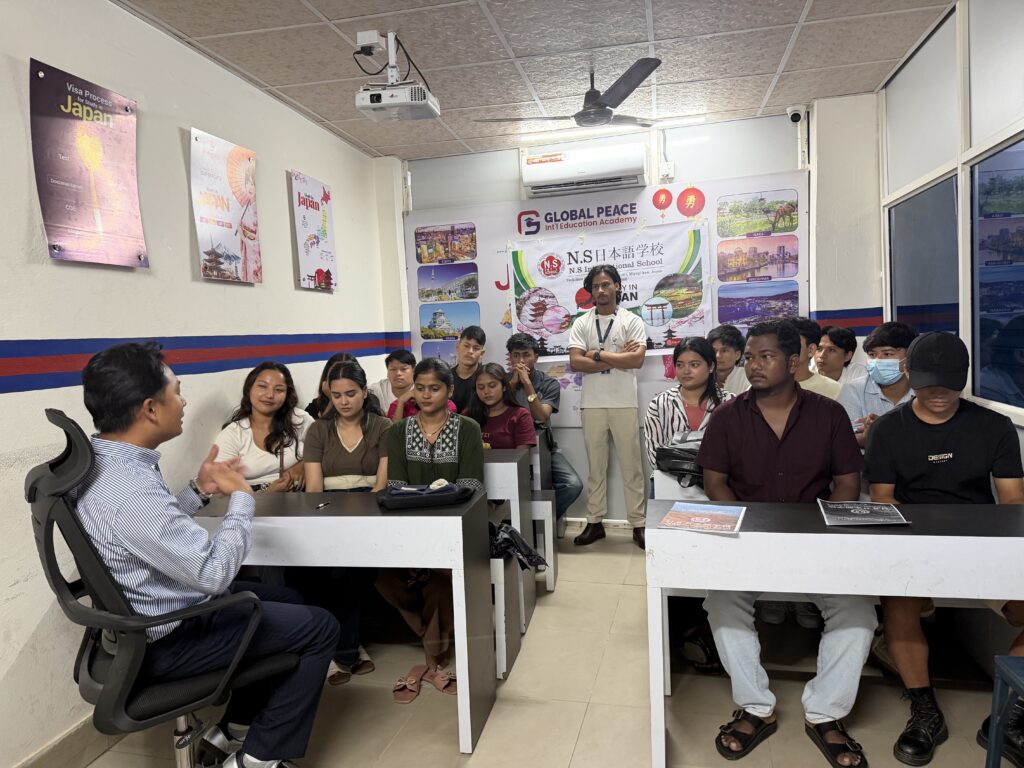
Back to Gallery Global Peace Birtamod Seminar September 2026 On September 2, Global Peace Birtamod organized an informative seminar at its BIrtamod Office , hosted by an official representative from a Japanese language school. The seminar aimed to guide students about Japanese lifestyle, culture, daily manners, and important do’s and don’ts to keep in mind while living and studying in Japan. Through the session, students learned about cultural differences, appropriate behavior, communication, discipline, and how to better prepare themselves for life in Japan. It was an insightful and engaging session that helped students gain practical knowledge and confidence for their future journey. Click to expand Edit gallery Edit gallery

Global Peace Birtamod September 2026 Read More »

Global Peace Itahari Organizes New Seminar – Sep 2026 |

On September 2, Global Peace Itahari organized an informative seminar at its Itahari branch for students preparing to study and build their future in Japan. The seminar was hosted by an official representative from a Japanese language school, who shared valuable information about Japanese culture, lifestyle, social manners, and everyday practices. The main purpose of the program was to help students understand what they may experience in Japan and prepare themselves for a smooth transition into a new cultural environment. During the seminar, students learned about the important do’s and don’ts of living in Japan. The session covered topics such as proper communication, punctuality, discipline, respect for others, cleanliness, public behavior, and workplace manners. Students were also introduced to some of the cultural differences they may encounter in their daily lives. These practical lessons helped students understand why following local customs and maintaining respectful behavior are important when living and studying in Japan. The seminar provided students with an opportunity to ask questions and gain a clearer understanding of life in Japan. The representative shared practical advice and experiences to help students become more confident and responsible before their journey. Overall, the session was informative, engaging, and useful for the students of Global Peace Itahari, giving them valuable knowledge about Japanese society and helping them prepare not only for their studies but also for their daily life and future opportunities in Japan.

Global Peace Itahari Organizes New Seminar – Sep 2026 | Read More »

Global Peace Itahari Seminar September 2026

Back to Gallery Global Peace Itahari Seminar September 2026 On September 2, Global Peace Itahari organized an informative seminar at its Itahari branch, hosted by an official representative from a Japanese language school. The seminar aimed to guide students about Japanese lifestyle, culture, daily manners, and important do’s and don’ts to keep in mind while living and studying in Japan. Through the session, students learned about cultural differences, appropriate behavior, communication, discipline, and how to better prepare themselves for life in Japan. It was an insightful and engaging session that helped students gain practical knowledge and confidence for their future journey. Click to expand Edit gallery Edit gallery

Global Peace Itahari Seminar September 2026 Read More »

GlobalPeace Kanji App Privacy

Privacy Policy & Terms of Use for Global Peace Kanji App Effective Date: July 5, 2026 Scope This Privacy Policy and Terms of Use apply only to the Global Peace Kanji App (Learn Kanji) developed by Global Peace Intl Education Academy. These policies do not apply to any other products or services operated by Global Peace Intl Education Academy, including but not limited to: Global Peace Website (globalpeace.com.np) Global Peace Official App Japanese Meaning App Global Peace Mock Test App Any other applications, websites, or services provided by Global Peace Intl Education Academy unless they explicitly state otherwise. Each of those services has its own Privacy Policy and Terms of Use where applicable. Privacy Policy Global Peace Intl Education Academy (“we”, “us”, or “our”) built the Global Peace Kanji App (Learn Kanji) as a free educational application. This Service is provided by Global Peace Intl Education Academy at no cost and is intended for use as is. This page explains our policies regarding the collection, use, and disclosure of information when you use this app. By using the Service, you agree to the practices described in this Privacy Policy. 1. Information Collection and Use For a better experience while using our Service, we do not require you to provide any personally identifiable information. The Global Peace Kanji App does not require you to create an account, and we do not collect or store your: Name Email address Phone number Password Any other personally identifiable information All study-related information, including: Study progress Daily streaks Reminder settings Kanji accuracy scores Learning preferences is stored locally on your device using local storage mechanisms (such as AsyncStorage). This information never leaves your device and is not transmitted to our servers. 2. Log Data Whenever you use our Service, in the event of an application error, we may collect diagnostic information through third-party services. This Log Data may include: Device IP address Device model Operating system version App configuration Date and time of use Error reports Other technical statistics This information is used solely to diagnose problems and improve the application. 3. Cookies Cookies are small data files commonly used as anonymous unique identifiers. The Global Peace Kanji App does not explicitly use cookies. However, certain third-party libraries or services integrated into the app may use similar technologies to improve functionality. You may choose to accept or refuse these technologies according to your device settings. 4. Links to Other Sites This Service may contain links to third-party websites or promote other applications developed by Global Peace Intl Education Academy, such as: Japanese Vocabulary JFT Mock Test If you click on a third-party link, you will be directed to that website or application. We strongly recommend reviewing the Privacy Policy of every external service you visit. We have no control over and assume no responsibility for the content, privacy policies, or practices of third-party websites or services. 5. Children’s Privacy This Service is not directed toward children under the age of 13. We do not knowingly collect personally identifiable information from children under 13 years of age. If we discover that a child under 13 has provided personal information, we will promptly delete that information from our systems. Parents or guardians who believe that their child has provided personal information may contact us so that appropriate action can be taken. 6. Changes to This Privacy Policy We may update this Privacy Policy from time to time. Any changes will be posted on this page and become effective immediately upon posting. We encourage users to review this page periodically for updates. 7. Contact Us If you have any questions or suggestions regarding this Privacy Policy, please contact: Global Peace Intl Education Academy Terms of Use By downloading or using the Global Peace Kanji App (Learn Kanji), you agree to these Terms of Use. Please read them carefully before using the application. The App, including its trademarks, copyrights, database rights, and all intellectual property, belongs to Global Peace Intl Education Academy. You may not: Copy or redistribute the App Modify any part of the App Attempt to extract or reverse engineer the source code Create derivative works based on the App Use our trademarks without permission 1. Use of the App Global Peace Intl Education Academy is committed to making the App useful and reliable. We reserve the right to: Improve or modify features Add or remove functionality Introduce paid services in the future If any paid features are introduced, users will be clearly informed before any charges apply. The App stores your study progress locally on your own device to provide learning features. You are responsible for keeping your device secure. We recommend that you do not jailbreak or root your device, as this may: Reduce device security Cause the App to malfunction Prevent certain features from working properly 2. Internet Connection & Third-Party Charges Some features of the App require an active internet connection, including: Fetching kanji definitions Loading translations Displaying stroke order animations Accessing online educational resources Internet access may be provided through Wi-Fi or your mobile network. Global Peace Intl Education Academy is not responsible for: Data charges imposed by your mobile provider Roaming charges Connectivity issues Reduced functionality caused by lack of internet access 3. Educational Content & Intellectual Property The dictionary and kanji data used within this application are provided by publicly available educational resources, including KANJIDIC and EDICT files from the EDRDG. While we strive to provide accurate educational content, we do not guarantee that all information is complete, current, or error-free. Global Peace Intl Education Academy shall not be liable for any direct or indirect loss resulting from reliance on the educational information provided within the App. 4. Updates & Termination We may update the App periodically to improve functionality or compatibility. The App is currently available for Android and iOS. Future platform availability may change. We do not guarantee continued support for every operating system version. We may discontinue or terminate the App or any part of the

GlobalPeace Kanji App Privacy Read More »

Mocktest Privacy

GLOBAL PEACE GP JFT MOCK TEST PRIVACY POLICY & TERMS OF SERVICE Last Updated: June 18, 2026 This document is a legally binding agreement between the user (“you”) and Global Peace (“we”, “us”, “our”) regarding the use of the GP JFT Mock Test Application and Web Interface  ⚠️ SCOPE OF THIS POLICY This Privacy Policy and Terms of Service applies only to the  user interface, including: GP JFT Mock Test App (Student/User version) Public or student-facing web test interface Practice tests, mock exams, and learning features 🚫 NOT COVERED UNDER THIS POLICY This policy does NOT apply to: Other standalone apps such as: Japanese Meaning App Kanji App JFT Mock Test Admin tools Global Peace Official App Internal institutional systems of Global Peace International Education Academy Each system may have separate policies. PART A — TERMS OF SERVICE 1. Eligibility You must be an authorized student or user enrolled in GP JFT Mock Test services to use this application. 2. Account Usage A user account may be created automatically upon enrollment You are responsible for maintaining confidentiality of login credentials All activity under your account is your responsibility 3. Acceptable Use You agree to use the platform only for: Learning and practicing mock tests Educational assessments Skill improvement You must NOT: Cheat, manipulate, or bypass test systems Share login credentials with others Attempt to exploit or disrupt the platform 4. Academic Integrity All test activities must be completed honestly. Any malpractice may result in: Score invalidation Account restriction Permanent access suspension 5. Service Availability We aim for continuous service, but: Temporary downtime may occur for maintenance We are not responsible for interruptions beyond our control 6. Termination We may suspend or terminate access if: Terms are violated Fraudulent activity is detected System misuse occurs PART B — PRIVACY POLICY 7. Information We Collect We collect only necessary data to operate the platform: A. Personal Information Name Email address Phone number Student ID (if applicable) B. Test & Learning Data Mock test answers Scores and performance results Progress tracking data Attempt history C. Technical Data IP address Device type Browser information Access timestamps 8. How We Use Your Information We use collected data to: Provide mock test functionality Track learning progress Display test results and analytics Improve system performance Ensure fair usage and prevent cheating 9. Data Storage & Retention Your data is securely stored in our systems during active use After course or usage completion: Your active account data may be archived or removed from live systems Essential records may be retained for verification, support, or academic reference 10. Data Sharing We do NOT sell or trade your personal data. We may share data only with: Authorized staff or instructors Internal support teams Legal or government authorities when required 11. Third-Party Services We may use trusted third-party services such as: Form tools (e.g., Google Forms) for tests Hosting and analytics infrastructure These services only process minimal required data and are not allowed to use it for advertising. 12. Cookies & Tracking (Web Only) Our web interface may use: Session cookies for login Security cookies for fraud prevention Basic analytics for performance improvement No advertising cookies are used. 13. Data Security We use industry-standard protections including: Encrypted communication (SSL/TLS) Secure authentication systems Access control mechanisms Regular monitoring for suspicious activity 14. Biometric Data (If Enabled) If biometric login is used: It is processed only on your device We do not store biometric data on servers Only authentication success/failure is received 15. Children’s Privacy This service is intended for educational users enrolled in programs under Global Peace. We do not knowingly collect data from users outside authorized educational enrollment. 16. Your Rights You may: Access your personal data Request correction of inaccurate information Request support regarding your account 17. Limitation of Liability We are not responsible for: User misuse of the platform Unauthorized account access due to user negligence External system failures beyond our control 18. Changes to This Policy We may update this policy at any time. Continued use of the platform means you accept any changes. 19. Contact Information Global PeaceWebsite: globalpeace.com.np For support, contact your assigned instructor or official support channel.

Mocktest Privacy Read More »

Privacy Policy for Global Peace Student App & Portal

 Scope of This Policy This Terms of Service and Privacy Policy applies strictly and exclusively to the Global Peace Official Mobile Application (iOS & Android) and its associated secure web portals, including the Student Dashboard and related internal systems operated under Global Peace. This policy governs only the usage of the above-mentioned official Global Peace digital platforms. 🚫 Excluded Applications & Systems This policy does NOT apply to any other applications, tools, or services operated independently or separately, including but not limited to: “Japanese Meaning App” “Kanji App” “JFT Mock Test App” Any other standalone learning or utility applications developed under different product lines Each of these applications may have their own separate Terms of Service and Privacy Policies, which govern their individual data practices and usage rules. Institutional Separation Clause This policy is also separate from and does not govern: Global Peace International Education Academy internal policies Any offline, physical classroom, or administrative procedures not connected to the official app or web portal systems Those systems and operations are governed by their own institutional rules, agreements, and policies. PART A — TERMS OF SERVICE 1. Eligibility You must be enrolled as a student or authorized user of Global Peace services to access the app and portals. By using the service, you confirm that all provided information is accurate and up to date. 2. Enrollment & Account Creation Upon enrollment in any course or program: A user account is automatically created in our system Required academic and personal data is securely added by default You are responsible for maintaining the confidentiality of your login credentials 3. Use of Services You agree to use the platform only for: Educational purposes Course participation Academic tracking and communication You must not: Attempt unauthorized access to systems Misuse or manipulate academic records Interfere with system security or operations 4. Academic Integrity Students must maintain honesty in all tests, quizzes, and assessments. Any form of cheating, impersonation, or manipulation may result in account suspension or termination. 5. Service Availability We aim to provide continuous access to services; however: Temporary downtime may occur for maintenance or upgrades We are not liable for disruptions beyond reasonable control 6. Termination of Access We reserve the right to suspend or terminate access if: Terms are violated Fraudulent activity is detected Misuse of the platform occurs 7. Governing Law This agreement is governed under applicable laws and regulatory frameworks of Nepal. PART B — PRIVACY POLICY 8. Information We Collect We collect only necessary information to operate educational and administrative services: A. Identity & Contact Information Name, date of birth, gender Address, email, phone numbers Guardian details Profile images for identification B. Academic & Visa Data Course enrollment details Academic performance (tests, quizzes, scores) Assigned teachers and batch information Visa-related status (if applicable) C. Financial Data Fee structure, payments, discounts, and outstanding balances We do not store banking credentials or card details 9. Enrollment Data Policy (Automatic Collection) When you enroll in any course or program under Global Peace: Your relevant personal, academic, and administrative data is automatically recorded into our system This data is required for identity verification, academic tracking, and service delivery Data is securely stored and accessible only to authorized personnel 10. How We Use Your Data We use collected data to: Manage student accounts and enrollment Conduct academic assessments Provide course-related communication Support visa and administrative processes Ensure system security and authentication 11. Data Retention & Removal Policy Upon completion of your course(s), your active digital profile will be removed from online systems (app and web portals) After removal, your account will no longer be accessible for operational use However, we may retain secure physical records and/or archived copies of essential data for: Verification requests Academic proof or certification support Issue resolution Legal or administrative compliance All retained records are stored securely and accessed only when necessary. 12. Data Sharing We do not sell or trade personal data. Data is shared only with: Authorized Global Peace staff Assigned teachers (limited access only) Government or visa authorities (only when legally required and with consent where applicable) 13. Data Security We implement strong security practices including: Secure token-based authentication Role-based access control Encryption and secure transmission Rate limiting and intrusion prevention systems OTP-based verification for sensitive actions 14. Biometric Authentication Biometric login (Fingerprint/Face ID) is processed only on your device We do not store or transmit biometric data Only authentication results are received by our system 15. System Logs & Monitoring We may collect system logs including: Login timestamps Device and browser information IP addresses Error and security logs These are used strictly for security and performance monitoring. 16. Third-Party Tools We may use secure third-party services such as: Google Forms for assessments or tests Only minimal necessary data is shared, strictly for academic purposes. No data is used for advertising. 17. Cookies (Web Portals Only) We use essential cookies for: Session management Security authentication Performance improvement We do not use advertising cookies. 18. Children’s Data Our services are intended for enrolled students. Where required: Guardian consent is assumed or obtained through institutional enrollment Guardians may request access or correction of student data 19. User Rights Users may: Request access to their data Request correction of incorrect data Request support regarding account or records 20. Policy Updates We may update this policy periodically. Continued use of the service indicates acceptance of changes. 21. Contact Information Global PeaceWebsite: globalpeace.com.np For support: Contact your branch administrator Or assigned teacher via official channels

Privacy Policy for Global Peace Student App & Portal Read More »